Loading content...
Wyoming County Map | WY Counties with Cities
The Wyoming County Map is an elaborate illustration of the 23 counties of Wyoming, showcasing the geographical areas, the biggest cities of this state, highways, and various other attractions. Wyoming is a state with huge landscapes, rough mountains, and a rich cultural history, where counties contribute to the management of the state, its historical development, and tourism.
It can be used to assist students, researchers, and travelers in learning more about the regional divisions of a state, both busy like Laramie and Natrona counties and more rural and picturesque like Sublette and Teton counties. This map is an effective educational resource that can be used to learn the administrative boundaries, demographic trends, and transportation networks.
Wyoming County Map
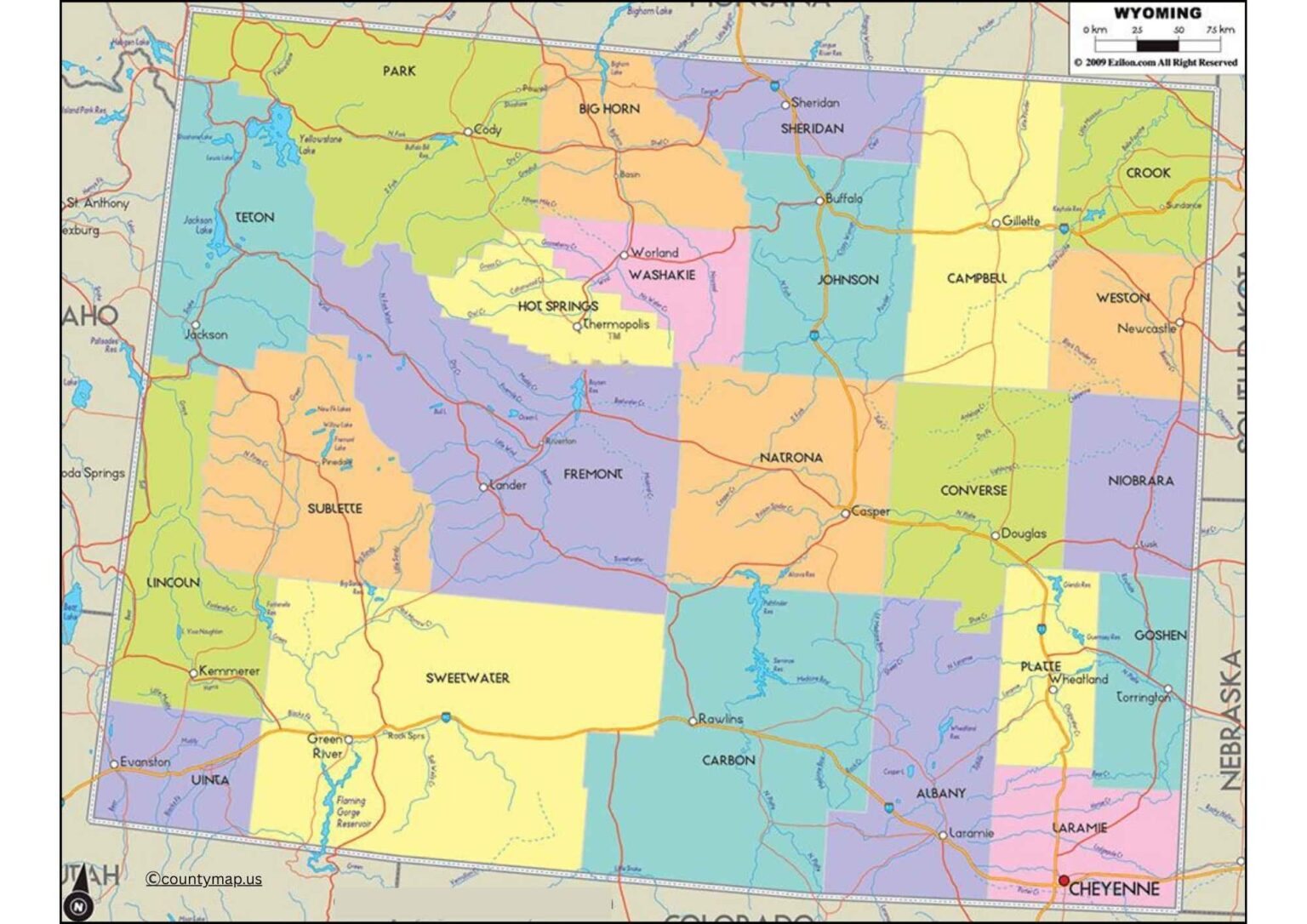
It also comes in handy when planning road trips or tourist destinations, or when one has to find out the economic or the historical importance of each county. The Wyoming County Map with Cities can serve purposes in both classrooms and research projects, as well as in planning a trip to the state; it is an available and clear view of the territorial uniqueness of the state and its geography.
The Wyoming county map with cities is a detailed map with the administrative and urban features of the state. Wyoming is a sparsely populated state comprising 23 counties in the Mountain West region of the United States that has cities, towns, and rural communities that are representative of the sparsely populated and expansive landscapes. The map offers attention to large cities like Cheyenne, Casper, Laramie, Gillette, Rock Springs, and Sheridan, and small towns that make up the economic, cultural, and historical landscape of Wyoming.
Printable Wyoming County Map with Cities
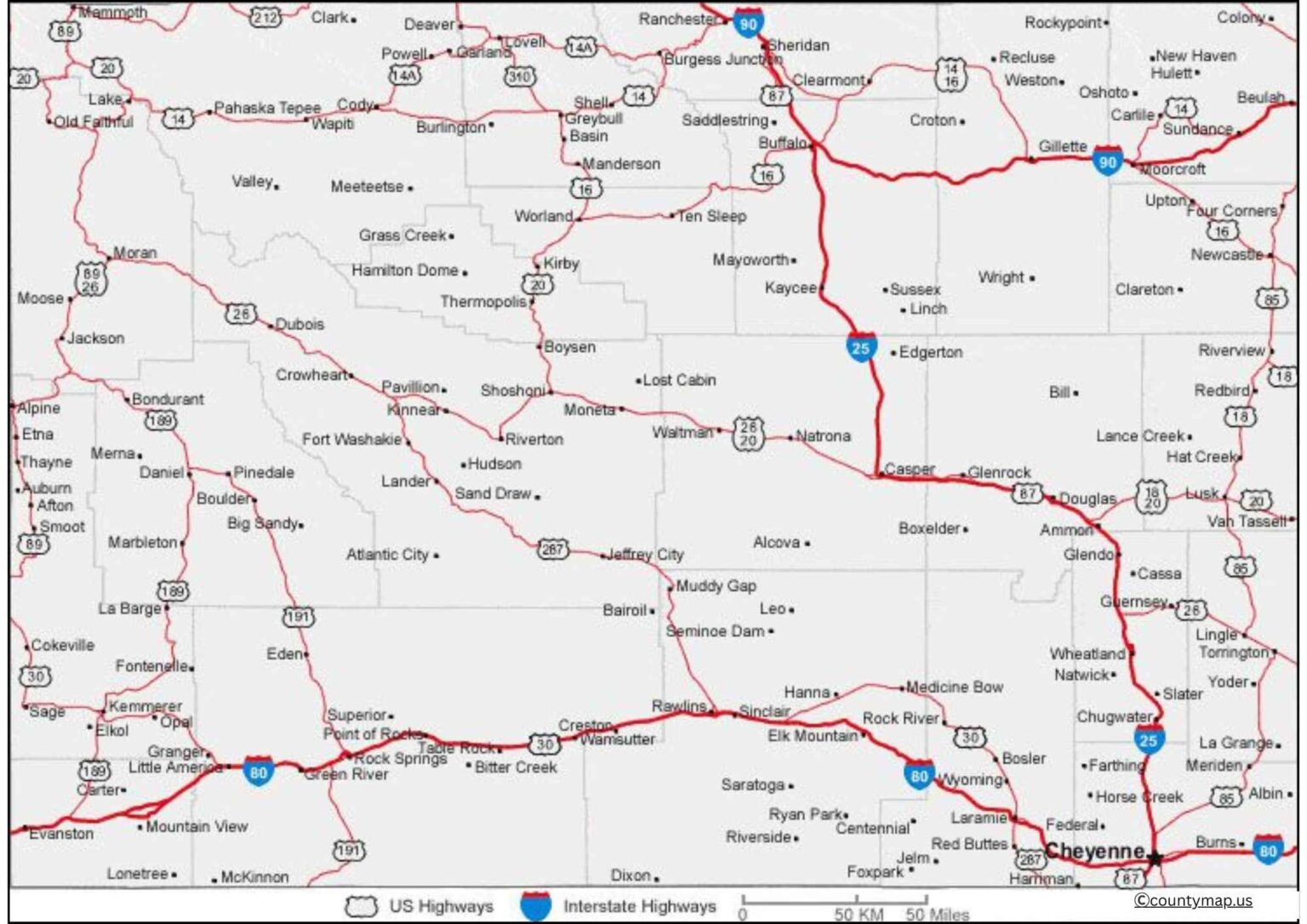
In Laramie County, Cheyenne, which is the largest city in the state, is a critical location in terms of government, trade, and transport. Casper is a significant energy, mining, and commercial center of central Wyoming in Natrona County. A small city in Albany County, Laramie, houses an education and research center, the University of Wyoming. Other major urban areas that serve coal mining, oil mining, and farming include Greensboro, Campbell County, Rock Springs in Sweetwater County, and Sheridan in Sheridan County.
The pictorial image of the county map with the cities depicts how the people are distributed in the mountainous terrain, high plains, and valleys of the river in Wyoming. The state has smaller towns that call attention to its historic and cultural value, especially in the field of tourism and outdoor recreation, such as Riverton in Fremont County or Cody in Park County. The connectivity of cities and counties with the help of large highways such as I-25, I-80, and I-90 can also be seen on the map.
The map is a valuable tool for knowledge on the settlement patterns, economic centers, and transportation patterns of Wyoming. It can be used by students, researchers, travelers, and residents who want to investigate the geographic and demographic distribution of the state in more detail.
The Printable Wyoming County Map with the capital centered on the Wyoming state capital of Cheyenne, which is situated in Laramie County in the southeastern part of Wyoming. Cheyenne is the political, administrative, and cultural center of the state, and the map shows the strategic position of the city in comparison with the other 22 counties.
Free Wyoming County Map with Capital
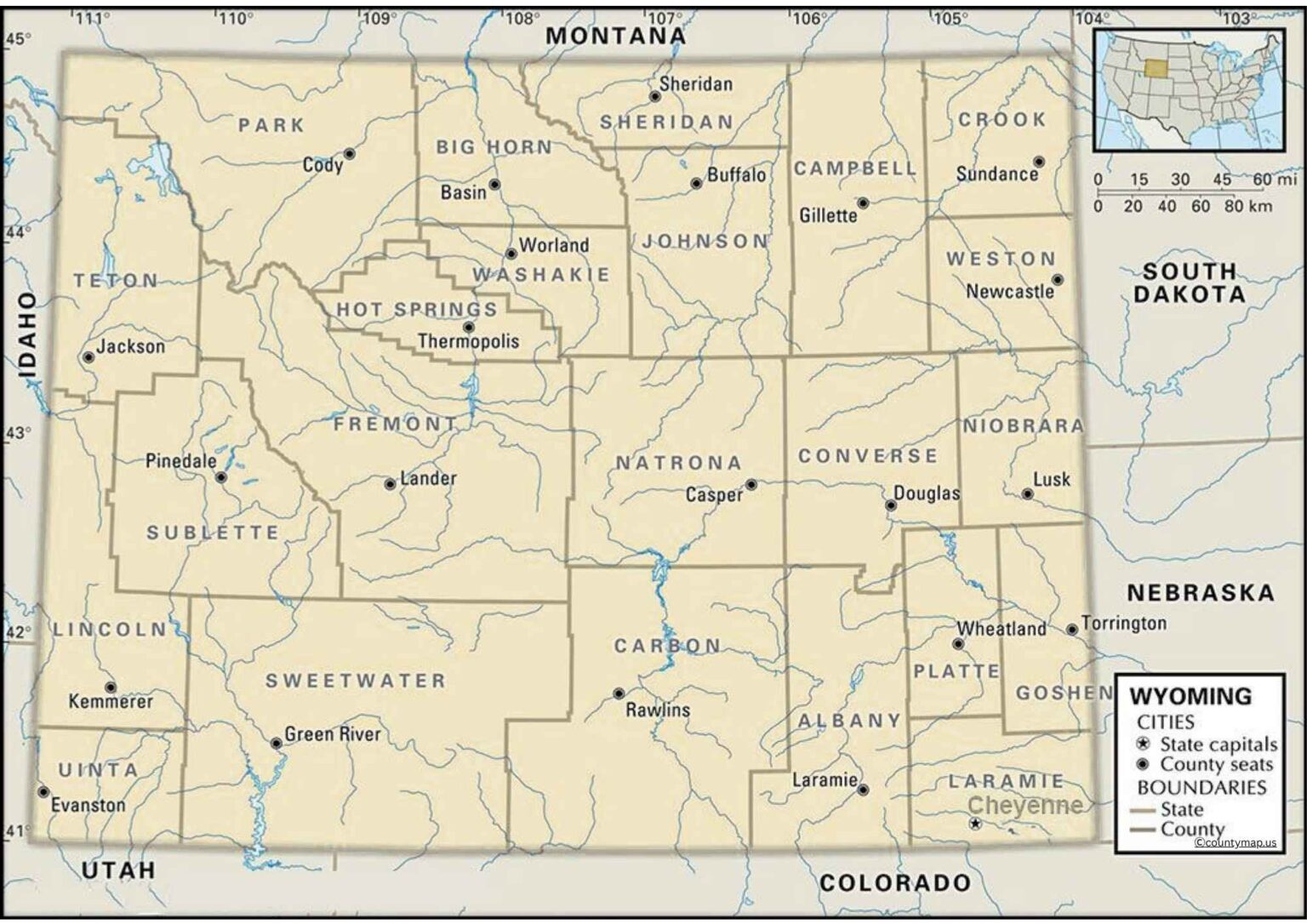
Cheyenne is the seat of government; it is the seat of the governor, the Supreme Court, and other state agencies. The fact that the city is close to the crossing of the main highways, such as I-25 and I-80, guarantees good connections with the northern, central, and western counties. The map shows how Cheyenne was strategic in the administration method and also depicts the connection between it and other large cities such as Casper (Natrona County), Laramie (Albany County), and Gillette (Campbell County).
The county-capital map shows the distinct pattern of settlement of Wyoming; most counties are sparsely populated, and it is important to note that Cheyenne is a central administrative and economic locale. It also brings into the spotlight the immediate counties like Albany, Platte, and Goshen that depend on the capital to provide government services, trade, and infrastructure planning.
The map helps students, planners, and researchers gain awareness of the governing system in Wyoming and the geographic context of the state by offering a visual account of Cheyenne compared to all the counties in the state. Cheyenne is a key determinant in the state, as is the historical importance of the state, its closeness to Colorado, and its function in energy and agricultural advancement. The county-capital map is thus necessary to comprehend the administrative structure of Wyoming, its geographical connectivity, and city-rural interactions.
Conclusion
The County Map of Wyoming Cities and Capital gives a full view of the state of the geography and government. The city's map shows the major urban centers in Cheyenne, Casper, Laramie, and Gillette, and indicates the way the population is distributed and economic centers exist in the 23 counties. The map of the capital underlines the strategic position of Cheyenne as the center of governance, infrastructure, and connectivity between rural and urban territories. Collectively, these maps can help a great deal in understanding the administrative characteristics of Wyoming, patterns of settlement, and its regional importance. They form an indispensable part of students, residents, planners, and travellers who would like to learn more about the demographic, economic, and political situation in the state.